
Gendercide is a Global Issue
Prenatal Elimination and Infanticide
There are times when we have to breathe and realise that some conversations aren’t easy. As we witness the growing groups of people jumping up and down at abortion clinics, spare a thought for the women who have to be selective in the timing of the tissue that needs removing, because at that time, medically, this is all it is.
From a critical criminological standpoint, state systems, the media and outside observers routinely choose the wrong targets for intervention or prevention. Individuals navigating their own peace of mind, healthcare and the timing of a pregnancy require absolute autonomy, privacy, and for external groups to quite simply mind their own business.
With this, the harassment seen outside clinics does nothing to address actual social harm; instead, it merely seeks to shame, unnerve, and expand ideological surveillance over individual bodies, and you simply don’t know what has happened to the women and girls involved.
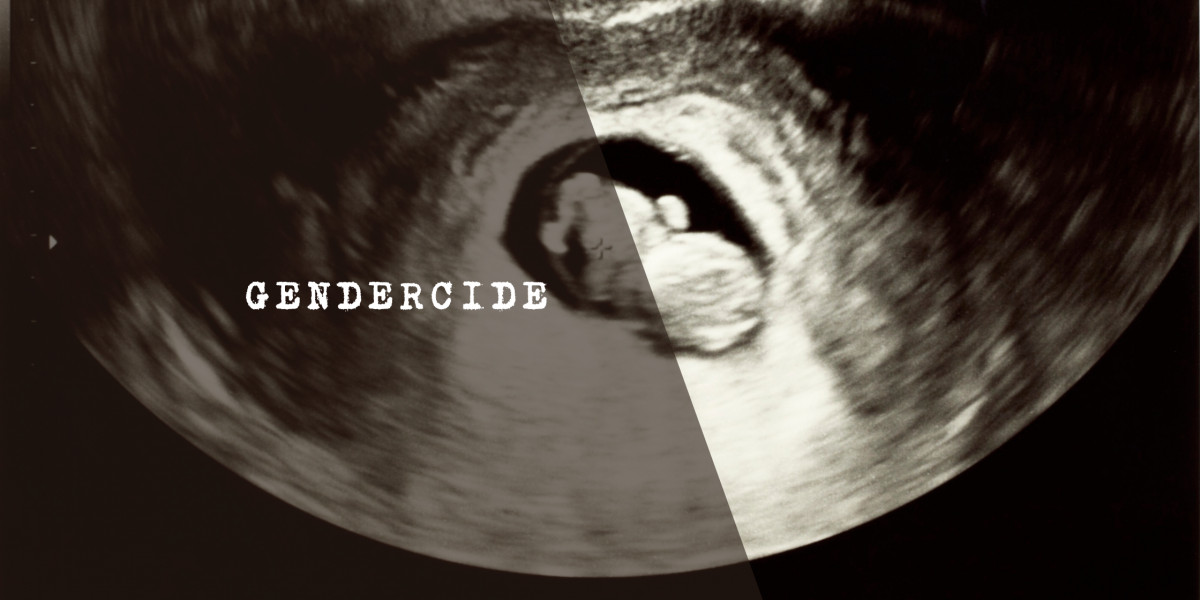
However, an absolute structural boundary must be drawn when a termination of pregnancy is forced, not by a woman or a girl making a self-determined choice about her life, but by systemic patriarchal forces intent on gender-based elimination. This is where individual reproductive freedom ends and gendercide begins. This distinction is a matter of documented demographic fact, and it is not advertised by the media or not up for debate on politics shows globally.
To understand why gendercide operates on a completely different structural plane than standard healthcare, we must look at three indisputable points:
- The Target is Identity, Not Timing: A standard abortion is a personal decision based on individual life circumstances. Gendercide is the systematic elimination of a specific group based entirely on biological sex. A female foetus is targeted and terminated solely for being female.
- The Driver is Systemic Force: True healthcare relies on individual agency. Gendercide is rarely a free choice. It is driven by intense structural coercion, where women face family violence, threats, and societal banishment or even lethal retribution for failing to produce a male heir.
- The Result is Global Harm: Standard healthcare access maintains the natural, healthy balance of a population. Gendercide violently warps it. It creates a massive, artificial shortage of women, which directly triggers a rise in international human trafficking and social collapse.
When we look at the global landscape, the issue is not a woman exercising autonomy over her own body. The issue is a global male system that weaponises technology (scanners) to eliminate females before they are even born.
The Illusion of Choice Under Structural Coercion
Critical criminology prompts us to look beneath the surface of apparent choices to uncover the structural dynamics of power, control, and state-sanctioned neglect. When a woman or girl walks into a clinic under the weight of systemic coercion, the concept of choice becomes an illusion. In societies where son preference is deeply entrenched, the pressure to produce a male heir is not a mild social preference. It is a coercive, violent apparatus enforced by familial units, local communities, and broader economic structures.
The distinction between a self-determined healthcare decision and sex-selective elimination lies entirely in the presence of structural force. This is no AI story, it is in the former scenario, as an individual evaluates her life circumstances, economic stability, or personal readiness. She exercises agency over her reproductive trajectory. In the latter scenario, the individual’s agency is systematically dismantled. The decision is dictated by a patriarchal hierarchy that views the female foetus as a financial liability and a male foetus as an asset.
There is another dimension to this line of thought and that from a purely functional, evolutionary, and reproductive standpoint, women are the bottleneck and the lifeblood of human survival. A population can recover from a massive loss of males in a single generation because, as we note, a handful of men can theoretically father thousands of children. However, if you lose your female population, the society faces immediate demographic collapse. It takes nine months of intense physical labour to grow a human, a resource consumption, and biological vulnerability to bring a single life into the world. However, by treating the female foetus as a liability and the male as an asset, patriarchal systems invert basic biological reality. They actively destroy the very resource required to keep their society evolving and surviving.
This is where state systems fail spectacularly in their duty of care. While state mechanisms often over-regulate and criminalise autonomous healthcare decisions, they simultaneously turn a blind eye to the structural violence that compels minority sex-selective practices. By failing to intervene in the root causes of son preference, such as unequal inheritance laws, dowry systems, and the economic disenfranchisement of women, the state becomes complicit in a form of surveillance that targets women for failing to conform to patriarchal demands.
The State as a Visible and Invisible Hand
To understand how gendercide proliferates, we must examine how state power manifests both through hyper-surveillance and calculated neglect. Criminological theory highlights that the state often regulates the wrong behaviours while ignoring systemic harms that result in mass victimisation. In the context of reproductive health, states frequently implement policies that police individual bodies, erecting legal barriers to autonomous healthcare. Yet, when technology is weaponised to systematically eliminate female foetuses, state intervention is frequently absent, sluggish, or performative by choice.
The introduction of affordable ultrasound technology in the late twentieth century serves as a prime example of this failure. Intended as a diagnostic tool to ensure safe pregnancies, it was quickly repurposed in several regions as a mechanism for prenatal sex selection. Rather than challenging the cultural and economic structures that made daughters financial burdens, states allowed the commercial market to exploit these prejudices.
When laws were eventually introduced to ban prenatal sex determination, they often lacked rigorous enforcement or targeted the wrong people. Instead of dismantling the patriarchal structures or providing robust social security nets for families with daughters, the legal framework merely pushed the practice underground. The state’s surveillance mechanisms remained fixated on regulating standard reproductive choices, leaving the structural drivers of gendercide unchallenged.
Furthermore, research indicates that this mind-set is not strictly confined to developing nations; studies coordinated by academic bodies like the University of Reading have examined how deep-seated son preference can manifest within diaspora communities in developed nations, illustrating that these patriarchal pressures cross borders.
Quantifying the Missing Women
The scale of this global phenomenon is not speculative; it is meticulously tracked by international human rights bodies. Data published by the United Nations Population Fund (UNFPA) reveals that globally, more than 140 million girls are considered ‘missing’ as a direct result of prenatal gender selection and gender-biased neglect.
The natural biological sex ratio at birth typically sits at approximately 105 boys for every 100 girls. However, in regions heavily impacted by systemic son preference, this balance has been shattered. According to joint research by agencies including UN Women and the World Health Organisation (WHO), birth ratios in parts of South, East, and Central Asia have historically soared to 130 boys for every 100 girls.
Demographic breakdowns from the Chr. Michelsen Institute (CMI) indicate that approximately 50% of these missing females are from China, while one-third are from India. In China alone, this artificial disparity means there are approximately 30 million more men than women within the population. This deficit is a direct consequence of not only policy, but also technology being weaponised within an unyielding patriarchal framework, proving that gendercide operates on a macro-scale completely detached from standard, individual healthcare.
Demographic Distortions and Social Collapse
The consequences of ignoring this structural boundary extend far beyond individual households. Gendercide causes severe macroeconomic and social harms that disrupt entire populations. Criminological research demonstrates a direct correlation between highly skewed sex ratios and an increase in systemic violence, social instability, and transnational crime.
As detailed in studies archived by the National Centre for Biotechnology Information (NCBI), the resulting surplus of young, unmarried men who face an artificial shortage of women leads to severe social friction. While some early theories hypothesised that this surplus would inherently drive outward aggression and societal violence, contemporary criminological and psychological research presents a more complex reality. These men are frequently marginalised, lonely, socially excluded, and highly prone to severe psychological distress, and what we see now is the rise of the AI or female Robot (this is a whole different blog to come later). This widespread alienation creates volatile social subcultures and fracturing communities.
Furthermore, this deficit of women drives a predatory, illicit global market. To meet the demand for brides in regions with severe gender imbalances, criminal syndicates scale up international human trafficking operations. Organised crime networks, “specialist households,” and trafficking rings routinely kidnap, deceive, and transport women and girls across borders to be sold into forced marriages or sexual servitude.
This is the ultimate trajectory of unchecked gendercide: the systematic elimination of females before birth directly fuels the commodification, trafficking, and enslavement of females after birth. The failure to protect autonomy at the prenatal stage culminates in a catastrophic loss of liberty on a global scale.
Redefining the Target for Critical Intervention
A progressive, critical approach to justice must shift its focus away from the private healthcare choices of individuals and toward the macro-systems that perpetrate genuine harm. Harassing women outside healthcare clinics does nothing to address the structural inequalities of the world. It is a misplaced deployment of alleged moral outrage that targets individual autonomy while leaving systemic violence completely untouched.
True intervention requires dismantling the patriarchal frameworks that make gendercide possible. International policy frameworks must hold states accountable for failing to address skewed sex ratios and the systemic violence that drives them. We must protect individual reproductive freedom from ideological surveillance while simultaneously deploying robust structural boundaries against the coercive elimination of women.
Autonomy as the Ultimate Boundary
Ultimately, the conversation around reproductive rights must become more nuanced, moving past superficial debates to confront the structural realities of power and coercion. A termination of pregnancy chosen freely by an individual is an exercise of bodily autonomy, a private healthcare decision that demands protection, privacy, and absolute freedom from external interference. Conversely, a termination forced by systemic patriarchal structures to eliminate a female life is an act of gendercide, a structural harm that demands global condemnation and rigorous institutional intervention.
By drawing this sharp, uncompromising boundary, we protect the integrity of individual choice while simultaneously exposing the mechanisms of global gender-based violence. The goal of critical justice should not be to surveil, judge, or restrict the individuals navigating their own private lives. The goal must be to dismantle the violent, systemic forces that seek to dictate who is allowed to be born, ensuring a world where every woman has the freedom to live, choose, and exist without fear of structural elimination.