
Do you know why bruises change colour?
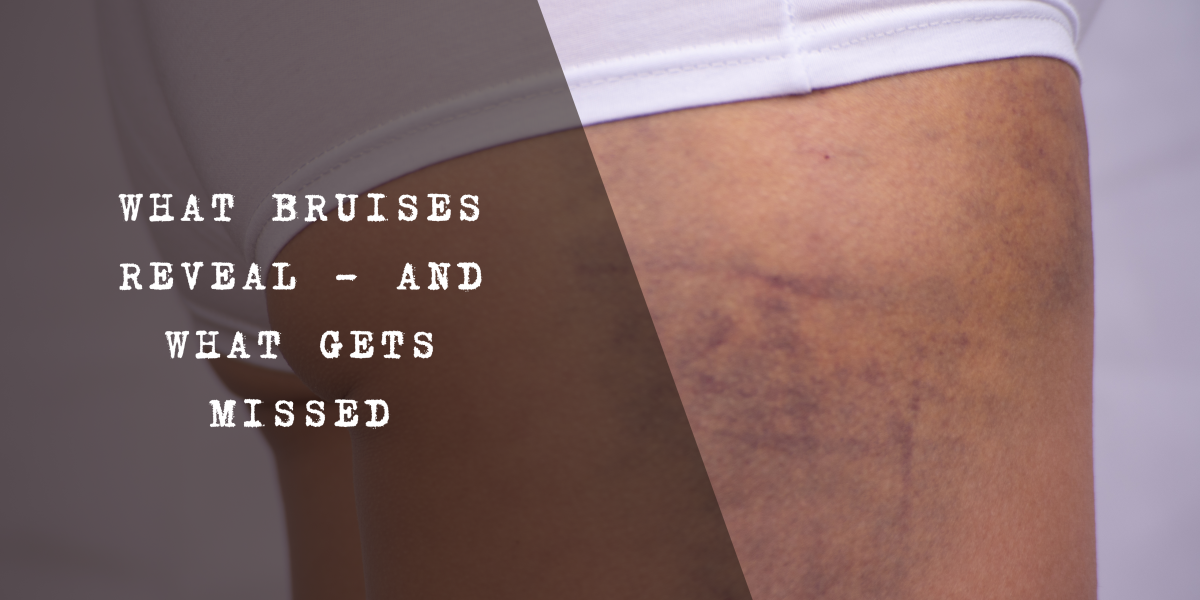
What Gets Missed?
I often sit with a cup of tea in hand, listening. I watch the tears roll down her face as she slowly unpacks what she calls being a failure. I bear witness to the bruising, fingerprinted into the skin along her collarbone and travelling up her neck, marking where he has gripped her with force. What I am seeing is not her failure, despite how she labels it, but something else entirely. It sits in the room with us, unspoken but evident, in the way she looks, in the way she carries herself, and in what she is trying to say.
The failure does not sit with her. It sits with those tasked with safeguarding at the most basic level, from agency to institution. It is the failure to listen without judgement or opinion. It is the failure to hear what is being said without distortion, the failure to guide appropriately, and the failure to offer even the simplest acknowledgement of what has happened to her. This is what I see as her case becomes marginalised.
As I hear her trying to prove her worth, it is not the job of a professional to prove her wrong or to dismiss her perspective. This is her reality, even where it differs from an official understanding of normality. Nor is it the role of an officer to reduce that reality into something more comfortable or plausible for them or a system to process. And yet, this is exactly where the shift happens.
The Distance of Disbelief
In a meeting with an interim police sergeant who has since left the force, he remarked that he thought everyone was pointing to some kind of conspiracy, almost scoffing as he said it. I pulled him on that comment, not to defend him, but to defend the professionals involved, because that is exactly what they are when advocating for women – professional! When a term like conspiracy is used without being trauma informed, it creates an immediate, dangerous distance. It shifts the focus away from what is actually there: the inconsistencies, the mistakes, the gaps, and the things not being joined together as they should be, is it corruption – well that for others to investigate, not for me, not for now anyway.
In doing so, the system reframes the problem to one of “he said, she said” or decides that the victim simply has issues. It is easy this way to diminish a case and close it. This institutional behaviour is used to justify what has been missed, allowing agencies to avoid resolving the structural chaos directly in front of us. But we have a dual standard here. If this were a celebrity or a sports personality, they would have every single service going. The state prioritises these high-profile cases because it is good for media coverage, allowing institutions to show the public how good they are at handling abuse. They prefer these polished public relations opportunities over the mundane, every day, complicated cases where there are simply too many threads hanging out of all the messiness. A significant part of this divide is down to money. High-profile individuals have the financial means to take immediate, high-powered legal action to protect themselves. Meanwhile, an everyday woman is left completely stranded, unable to afford private representation and blocked from accessing a legal aid system that is currently in a state of total collapse.
When those early points in a case are not recognised or properly understood, the investigation is set on the wrong footing from the outset. That poor framing then carries through every single stage of the process. It becomes embedded in how information is interpreted, how decisions are made, who gets to form an opinion, and how the narrative develops. What follows is not clarity or justice but increasing fragmentation. The case becomes harder to ground in what actually happened, shaped instead by competing bureaucratic narratives. Without these institutional inconsistencies, there would be nothing to question, nothing to connect, and no basis for their dismissive conclusions at all.
Under the Victims’ Code, every victim has the statutory right to be treated with respect, sensitivity, and without judgement, and to be taken seriously. That is not a casual suggestion. It is the absolute standard expected of anyone in authority. It means giving a woman the opportunity to explain what has happened in her own words, properly listening to what she is saying, and supporting her in a way that allows her experience to be understood on her terms. It means creating an environment where she feels safe to speak, and where her voice is recognised as a core part of the process.
Instead, I hear her describe interviews with female officers whose responses are shaped by a quiet misogyny. It is a prejudice against women like her, functioning as if there were a hidden hierarchy of whose lives are worthy of understanding and whose are not. Her life does not fit neatly within their values, beliefs, or biases, including those shaped by political and religious views.
These gaps matter. They shape what is believed, how a case is constructed, what is recorded, the nature of secondary referrals, and what is ultimately dismissed. In that process, the victim begins to disappear entirely. This leaves us with a troubling question for policymakers: is this what the government truly means when it promises to halve violence against women?
The Reduction of Physical Evidence
I am not here to write another recycled explanation of bruising or how professionals should treat people. What is needed is a far more careful approach, a way of connecting professional assumptions to biological reality. What is recorded in professional settings must be both accurate and meaningful, without distortion or exaggeration as it moves through different accounts, from call handler to officer, and from officer to officer, where vital detail is routinely reduced or lost altogether.
The police often see bruising, but it is rarely understood in the context in which it sits. It is present on the body, visible and observable, yet it is quickly absorbed into routine practice, noted without weight, or passed over without being held in place. In many professional settings, evidence is not entirely absent; it is simply reduced. It is reduced in how it is recorded, reduced in how it is interpreted, and reduced in how it is carried forward. What should form part of a wider, escalating picture is instead contained to a single moment. It becomes a one-off, an isolated mark, detached from history and stripped of context.
Through that process, meaning is lost. This happens not because the meaning is not there, but because the system refuses to allow it to develop. This process is not neutral. It is actively shaped by who is observing, what they expect to see, and the rigid frameworks within which they are working. What is recorded is not simply what is visible on the skin, but what the officer recognises as relevant to their paperwork.
In practice, this has devastating consequences. Time passes, appointments are delayed, and by the time a professional is finally in a position to observe the victim, the bruise has faded. What needed to be recorded immediately is no longer visible. What could have contributed to a wider picture of escalation is gone forever. What is not recognised by the system is never evidenced in court.
The Reality of Biological Processes
To challenge this systemic minimisation, professionals must understand that bruising is a living process rather than a fixed indicator of time. Within the first twenty-four hours of an injury, a bruise often appears red as fresh, oxygen-rich blood pools beneath the skin. On darker skin tones, this phase may not appear visibly red but presents as a distinctly darker or swollen area.
After one to two days, the trapped blood begins to lose oxygen and change colour, appearing blue, purple, black, or darker than the surrounding skin. By day five to ten, as the body breaks down haemoglobin, the compounds biliverdin and bilirubin may turn the bruise green or yellow, though on darker skin tones this stage usually presents as a gradual lightening rather than a distinct colour shift. Finally, between ten and fourteen days, the mark fades into a brown hue before disappearing entirely.
This biological progression is not a fixed timeline. It is a highly variable process that refuses to sit in isolation for the convenience of a police report. A bruise will not present the same way every time, and it will not move through these stages in predictable or fixed ways. A professional may see multiple colours present at once. Variations will always occur depending on the individual build, their specific circulation, environmental temperature, and the nature of the force that caused the injury.
What matters is that professionals stop attempting to assign a false sense of certainty where there is none. What matters is recognising the vulnerable person in front of you and recording the physical evidence properly.
The size, the shape, the location, the pattern, and the colour must be documented clearly at the exact point of observation. Then, crucially, professionals must return to it. It is through repeated observation and consecutive reports that a true picture begins to form. Patterns begin to emerge. Injuries that may appear isolated start to connect, and that is where bruising becomes meaningful. It becomes evidence not in a single moment, and not through systemic assumption, but through careful observation, accurate recording, and the willingness to look again.
When you are faced with someone like her, take a moment and hold it there. You do not need to resolve the entire case in that instant, and you do not need to force her reality into something you already understand. What you are being given is her account, her body, and what is visible in front of you. The role of a professional is to stay with that reality, to listen, and to document the truth before it fades away.